New open-access book brings together four years of research, experimentation and learning on culture and creativity in non-urban areas across Europe
How can culture and creativity contribute to the development of places beyond major cities? And what can non-urban communities teach us about the relationship between culture, creativity, innovation and place?
A new book emerging from the European research project IN SITU – Place-based Innovation of Cultural and Creative Industries in Non-urban Areas explores these questions through research and experiences from six diverse European regions.
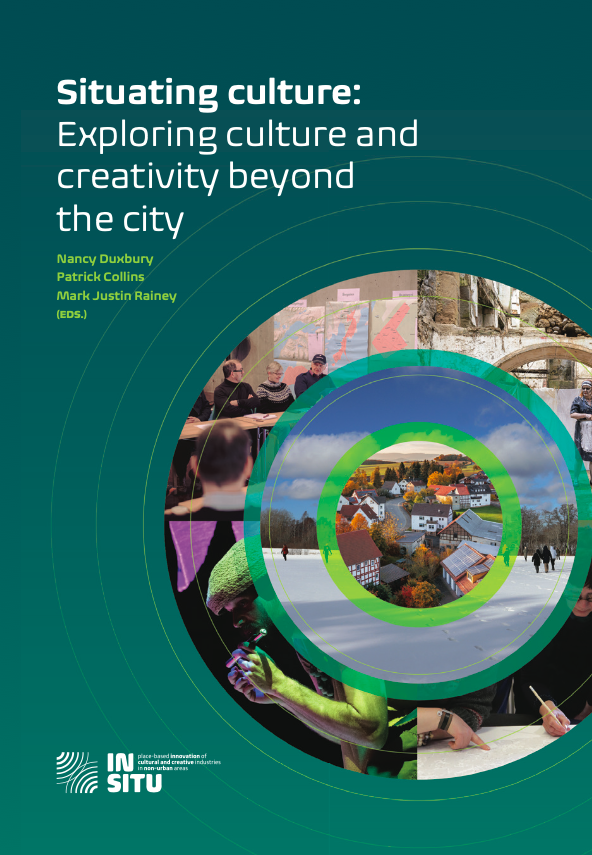
Situating Culture: Exploring Culture and Creativity beyond the City, edited by Nancy Duxbury, Patrick Collins and Mark Rainey, brings together insights developed throughout the four-year IN SITU project. Published by the Centre for Social Studies of the University of Coimbra, the volume examines how cultural and creative practices are shaped by their local contexts and how they can contribute to more vibrant, resilient and sustainable non-urban places.
Putting non-urban places at the centre
Culture and creativity are often discussed through an urban lens, with cities frequently treated as the natural centres of cultural production, innovation and creative economies. Situating Culture challenges this perspective by turning attention to the distinctive cultural and creative ecosystems that exist beyond the city.
The book draws on the IN SITU project’s work across six European regions—the Azores (Portugal), Galway and the West of Ireland, West Iceland, Rauma and Eurajoki (Finland), Latvia, and Croatia—and reflects on what happens when cultural and creative development is approached from the specific realities, resources and aspirations of each place.
Rather than proposing a single model for cultural development, the volume emphasises the importance of place-based approaches: approaches that recognise local knowledge, relationships, histories, infrastructures and capacities as fundamental to how cultural and creative activity develops.
From research to experimentation
IN SITU, a four-year Horizon Europe project coordinated by the Centre for Social Studies of the University of Coimbra, investigated how Cultural and Creative Industries (CCIs) can contribute to innovation and development in non-urban areas.
At the heart of the project were six IN SITU Labs, established in the participating regions to experiment with place-based approaches to cultural and creative development. These Labs brought researchers, cultural and creative practitioners, local organisations, policymakers and communities together to develop and test new ideas in real-world contexts.
The project combined research with experimentation, capacity building and policy development, producing practical tools and recommendations alongside academic knowledge. Its work addressed questions including how local creative ecosystems function, how cultural and creative actors can build capacity, how innovation can be supported outside urban centres, and how cultural and innovation policies can better respond to the realities of non-urban places.
Situating Culture is therefore more than a collection of academic contributions: it represents a synthesis of four years of learning across the IN SITU regions, bringing different places and perspectives into dialogue.
“Towards culturally vibrant peripheries”
The book’s concluding reflections consider the insights emerging across the IN SITU Labs and ask what they reveal about the future of cultural and creative development in non-urban areas. The volume argues for moving beyond deficit-based understandings of rural and peripheral places and recognising their cultural and creative potential on their own terms.
The publication also contributes to a growing body of research examining how culture can be embedded in locally grounded approaches to development. By bringing together comparative perspectives from different European contexts, it highlights both the diversity of non-urban places and the common challenges and opportunities they face.
A lasting legacy of IN SITU
The launch of Situating Culture marks an important milestone in the legacy of IN SITU, whose four-year programme concluded on June 2026.
The book complements the project’s wider body of research, policy recommendations, methodological resources and practical tools, ensuring that the knowledge generated through the project continues to be available to researchers, policymakers, cultural and creative practitioners and communities.
As the project comes to an end, its central message remains highly relevant: culture matters in every place. And understanding where culture happens is essential to understanding what it can make possible.
For further information:
Nancy Duxbury – IN SITU Project Coordinator
Centre for Social Studies (CES) at the University of Coimbra, Portugal
Email: in-situ@ces.uc.pt
Tel: +351 239 855 570
Web: https://insituculture.eu
The “IN SITU: Place-based innovation of cultural and creative industries in non-urban areas” project combines research and experimental actions to advance the innovation-related practices, capacities, and potential of cultural and creative industries (CCIs) based in non-urban areas of the EU. The project is funded by the European Commission under the Horizon Europe Program (project no.101061747). It began on July 1, 2022, and will run for four years. The IN SITU project consortium comprises 13 Full Partners from 12 countries, consisting of 11 research institutions, a European-wide cultural network, and a national cultural foundation.